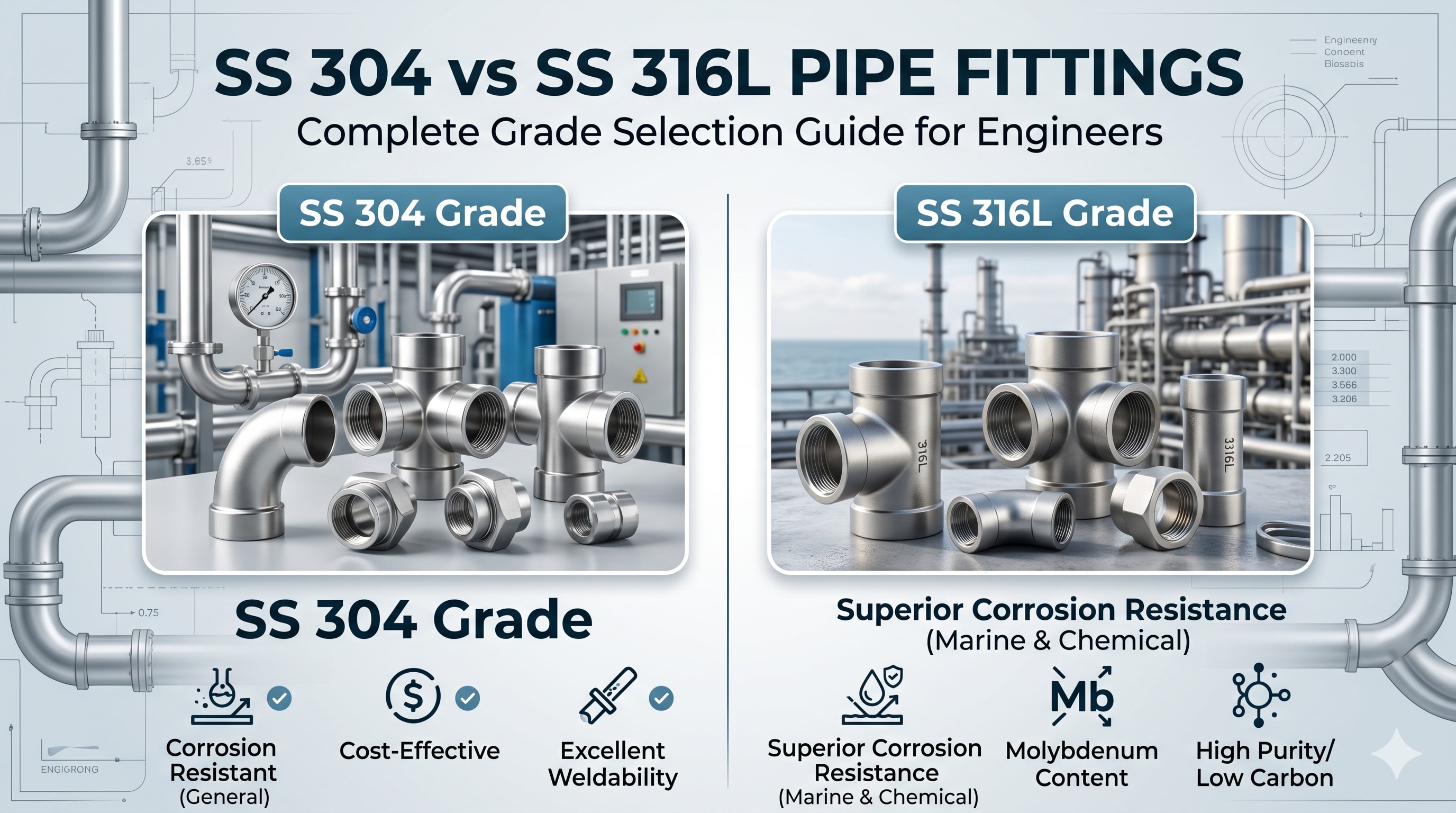
SS 304 vs SS 316L Pipe Fittings: Complete Grade Selection Guide for Engineers
Published by Angel Metal & Alloys, Ahmedabad | Technical Resource
The single most common mistake engineers make when specifying stainless steel pipe fittings is treating grade selection as an afterthought. They pick SS 304 because it is cheaper, or SS 316L because it "sounds better" — without understanding why one grade outperforms the other in specific environments. This guide eliminates that guesswork.
At Angel Metal & Alloys, we manufacture and export SS pipe fittings, flanges, and forged components from Ahmedabad to 30+ countries. Every week, our technical team answers the same question from procurement engineers across India, UAE, Singapore, and the UK: "Which grade should I specify for this application?"
This article gives you the engineering answer — clearly, without jargon.
What Makes SS 304, SS 316, and SS 316L Different?
All three grades are austenitic stainless steels — they share the same face-centred cubic crystal structure, non-magnetic properties (when annealed), and good ductility. The differences come down to chemical composition.
SS 304 — The Universal Grade
SS 304 contains approximately 18% chromium and 8% nickel. This is why it is also called the "18/8" grade. The chromium forms a passive oxide layer on the surface that resists oxidation and moderate corrosion.
Chemical composition (ASTM A182):
- Carbon: max 0.08%
- Chromium: 18.0–20.0%
- Nickel: 8.0–10.5%
- Molybdenum: None
SS 304 is the workhorse of the stainless steel industry. It handles most clean water systems, food and beverage processing lines, general chemical storage, dairy equipment, and architectural applications perfectly well. In India, the majority of hospital furniture, food processing equipment, and pharmaceutical vessel exteriors use SS 304.
SS 316 — The Molybdenum Upgrade
SS 316 adds 2–3% molybdenum to the SS 304 formula. This single addition dramatically changes performance in aggressive environments. Molybdenum stabilises the passive oxide layer against chloride attack — the primary cause of pitting corrosion in stainless steel.
Chemical composition (ASTM A182):
- Carbon: max 0.08%
- Chromium: 16.0–18.0%
- Nickel: 10.0–14.0%
- Molybdenum: 2.0–3.0%
The practical result: SS 316 pipe fittings can handle seawater, marine atmospheres, chlorinated cleaning agents, dilute hydrochloric acid, sulphuric acid, and phosphoric acid — environments where SS 304 would pit and fail within months.
SS 316L — The Weld-Safe Version
The "L" in SS 316L stands for Low carbon. The maximum carbon content drops from 0.08% to 0.03%. This matters because carbon causes a phenomenon called sensitisation during welding — carbon migrates to grain boundaries and forms chromium carbide, depleting the chromium available to form the protective oxide layer. The result is intergranular corrosion at weld joints.
By reducing carbon below 0.03%, SS 316L virtually eliminates sensitisation risk. This makes SS 316L the mandatory choice for any application involving site welding, multi-pass welding, or welded assemblies that cannot be solution-annealed after fabrication.
In practice: In India, pharmaceutical plants, dairy processing lines, and chemical reactors almost universally specify SS 316L for all welded pipe fittings and flanges. The additional cost over SS 316 is negligible compared to the risk of weld zone corrosion failures.
Head-to-Head Comparison Table
| Property | SS 304 | SS 316 | SS 316L |
|---|---|---|---|
| Chromium % | 18–20 | 16–18 | 16–18 |
| Nickel % | 8–10.5 | 10–14 | 10–14 |
| Molybdenum % | None | 2–3 | 2–3 |
| Carbon % max | 0.08 | 0.08 | 0.03 |
| Corrosion resistance | Good | Excellent | Excellent |
| Chloride resistance | Moderate | High | High |
| Weldability | Good | Good | Excellent |
| Sensitisation risk | Low | Low | None |
| Cost (relative) | ₹ | ₹₹ | ₹₹ |
| ASTM Forged Fittings | A182 F304 | A182 F316 | A182 F316L |
| ASTM Butt Weld | A403 WP304 | A403 WP316 | A403 WP316L |
Industry-by-Industry Selection Guide
Pharmaceutical Industry (India — Dahej, Ankleshwar, Vapi)
Specify: SS 316L for all process pipe fittings, flanges, and valves
Pharmaceutical manufacturing requires high-purity piping. Clean-In-Place (CIP) and Sterilisation-In-Place (SIP) systems use hot caustic solutions and steam — both of which attack SS 304 over time. More critically, CIP chemicals often contain chlorinated compounds that cause chloride pitting in SS 304.
SS 316L is mandated by cGMP guidelines for product contact surfaces. The low carbon content ensures no contamination from sensitised weld zones, which is critical for injectable and API manufacturing lines.
Angel Metal & Alloys supplies SS 316L butt weld fittings, flanges, and forged fittings to several pharmaceutical SEZs in Gujarat, including Dahej and Jambusar.
Chemical Industry (Gujarat — Ankleshwar, Nandesari, Vapi)
Specify: SS 316L for most applications; Duplex 2205 for high-chloride and high-pressure services
Gujarat's chemical belt processes everything from acetic acid and caustic soda to chlorine compounds and sulphuric acid. The correct grade depends on the specific chemical and its concentration:
- Dilute sulphuric acid (< 10%): SS 316L
- Phosphoric acid: SS 316L
- Chlorine compounds or hydrochloric acid: Duplex 2205 or Hastelloy C276
- Acetic acid: SS 316L
- Caustic soda: SS 304 or SS 316L (both perform well)
- Nitric acid: SS 304 (316 performs worse in concentrated nitric acid)
Oil & Gas Industry (ONGC Hazira, Reliance Jamnagar)
Specify: Duplex 2205 or SS 316L depending on service
For offshore and sour service applications containing hydrogen sulphide and CO₂, duplex stainless steel (UNS S31803) is the preferred choice. SS 316L is used for utility services, instrument tubing, and non-sour process lines.
Dairy & Food Processing (Gujarat — Mehsana, Anand)
Specify: SS 316L for product contact; SS 304 for structural and non-contact
Food-grade piping requires smooth, crevice-free internal surfaces that can withstand CIP chemicals. SS 316L is standard for milk lines, fermenter connections, and heat exchanger headers. SS 304 is acceptable for water services and structural supports.
Water Treatment Plants
Specify: SS 304 for clean water; SS 316L for brackish or seawater
Municipal water treatment (chlorination levels < 0.5 ppm) is well handled by SS 304. Desalination plants, coastal water treatment, or systems using aggressive chlorinated biocides should use SS 316L as the minimum, with Duplex 2205 for high-temperature services.
The 5-Question Grade Selection Checklist
Before specifying any SS pipe fitting or flange, answer these five questions:
1. Is chloride present in the fluid or environment? Yes → Use SS 316L minimum. High chloride (> 200 ppm) or marine environment → Duplex 2205.
2. Will any fittings be field welded without post-weld heat treatment? Yes → Specify "L" grade (316L, 304L) to prevent sensitisation.
3. Does the application involve temperature above 400°C? Yes → Use SS 321 (titanium-stabilised) or SS 347 (niobium-stabilised) instead — they handle high-temperature cycling without carbide precipitation.
4. Is the fluid highly oxidising (concentrated nitric acid)? Yes → SS 304 or SS 310 performs better than SS 316 in this specific case.
5. Is cost the primary constraint with benign environment? Yes → SS 304 is entirely appropriate and significantly more economical.
Mill Test Certificate: What to Check
When procuring SS pipe fittings or flanges, always demand a Mill Test Certificate (MTC). For SS 316L, verify:
- Carbon content is listed as ≤ 0.03% (not just "316L" written without test data)
- Molybdenum is between 2.0% and 3.0%
- Heat number is traceable to the original mill
- PMI (Positive Material Identification) test report matches MTC data
At Angel Metal & Alloys, every consignment is dispatched with full MTC traceability, spectroscopy test reports, and dimensional inspection certificates.
Summary: Quick Reference
| Application | Recommended Grade |
|---|---|
| General water, food, structural | SS 304 |
| Welded assemblies, general corrosive | SS 304L |
| Chemical processing, marine, CIP | SS 316L |
| Pharmaceutical process lines | SS 316L |
| High temperature > 400°C | SS 321 |
| Very high temperature / furnace | SS 310 |
| Offshore, high chloride, high pressure | Duplex 2205 |
| Extreme chloride, HCl, seawater high temp | Super Duplex 2507 |
| Hydrochloric acid, strong acids | Hastelloy C276 |
Get the Right Grade for Your Project
Angel Metal & Alloys manufactures and stocks all the grades listed in this guide — from SS 304 to Super Duplex 2507 — in butt weld fittings, flanges, forged fittings, pipes, and fasteners. Our technical team in Ahmedabad provides free grade recommendation for your specific application.
Call us: +91 9974334455 | +91 9825003949 Email: angelmetalalloys@gmail.com WhatsApp: +91 9974334455
Angel Metal & Alloys, B-917 Sun West Bank, Ahmedabad – 380013, Gujarat, India